Annual Report
2025 Youth Outdoor Policy Trends Report
Our annual trends report shares innovative ideas in youth outdoor engagement to inspire legislators, advocates, communities, and youth to replicate, rethink, and collaborate on equitable youth outdoor opportunities.
Overview
Outdoor policy continued to grow in 2025, with 47 states and territories introducing over 300 bills on outdoor recreation, education, access, and equity.
This report summarizes policy trends, initiatives, and specific bills enacted in 2025 across:
- Outdoor Equity & Justice
- Outdoor & Environmental Learning
- Outdoor Health & Wellbeing
- Outdoor Access & Leadership
- Federal Policy Related to State Efforts
- New and Exciting Outdoor Ideas
The 2025 Trends Report shares innovations to inspire legislators, advocates, communities, and youth to replicate, rethink, and collaborate on equitable youth outdoor opportunities. For a more comprehensive look at Outdoor Engagement legislation, see NCEL’s Outdoor Engagement issue page.
View the full report as a PDF below.
Jump to a Section: General Trends | Equity & Justice | Learning | Wellbeing | Access and Leadership | Federal Policy | Exciting Ideas
Methods
These bills were identified by the Youth Outdoor Policy Partnership, including the Children & Nature Network, the North American Association for Environmental Education, the National Caucus of Environmental Legislators, and Nuestra Tierra.
As a partnership, we do not endorse any specific bills or policy ideas. We share these examples to inspire local champions and legislators to consider what might work in their state. This is not a comprehensive list, and we welcome suggestions for additions or corrections at grant@ncelenviro.org.
YOPP’s New Logo
The Youth Outdoor Policy Playbook (YOPP) has a new logo that reflects its mission through rich cultural symbolism and intentional design. Created by Anishinaabe artist Marissa Indoe of the Chapleau Ojibwe First Nation, the logo weaves together themes of leadership, collaboration, and harmony with the natural world.
General Trends
Outdoor policy continued to grow in 2025, with 47 states and territories introducing 303 bills on outdoor recreation, education, access, and equity. When bills are introduced, it means that state lawmakers are officially considering making them laws.
Of the over 300 bills introduced this session, 62 bills were enacted in 28 states and territories. This means they became laws. As of early 2026, five additional bills were waiting on a governor’s signature in order to become law.
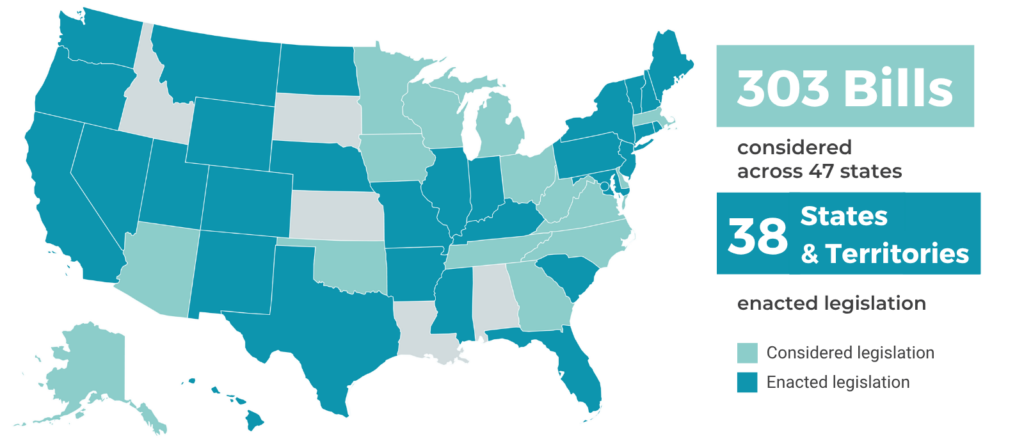
A total of 62 bills enacted out of 303 bills introduced means about 20%, or one in five, of all outdoor bills that were introduced became law. For reference, only about 16% of all bills introduced in state legislatures become law. Outdoor bills became laws 25% more often than average.
Emerging Trends in 2025
Emerging outdoor policy trends in 2025 included:
- outdoor disability accessibility
- outdoor education for all
- trails access for all
- new or expanded outdoor funding
Outdoor Equity & Justice
States explored ways to address historic and ongoing injustices through a continued focus on disability access and transportation, as well as an emerging focus on honoring Tribal sovereignty.
Disability Access
At least eight states (AK, CA, HI, MT, NJ, NY, NC, UT) introduced legislation to help disabled people spend meaningful time outside.
2025 Policy Advancements
- California A.B.1225, if signed by the governor, will establish an Accessibility Advisory Committee to advise on improving disability access in state parks.
- Montana S.B.238 created a program to support bowhunters with disabilities, which is funded by optional donations added to hunting licenses. The money is used to help non-profit organizations buy modified archery equipment for hunters who need it.
Transportation
This year also saw continued interest in transportation to outdoor spaces. Transportation remains one of the most significant barriers to outdoor recreation.
Tribal Sovereignty
Tribal sovereignty in the outdoors means respecting the treaty rights of Tribes to access, hunt, fish, and gather on most land. These agreements work both ways: states must uphold and protect these inherent Tribal rights if states want to continue accessing and managing non-Tribally-governed land across the United States.
However, the treaty rights securing Indigenous outdoor access are not always honored, and state park entrance fees are one way these rights are sometimes broken. Some states are working to fix this. For example:
2025 Policy Advancements
- Colorado enacted H.B.25-1163, which officially recognized the rights of the Southern Ute Indian Tribe and Ute Mountain Ute Tribe by allowing enrolled Ute Tribal citizens to enter state parks without paying a fee.
- Connecticut also looked into confirming the fishing, hunting, and aquaculture rights of Native American Tribes and Tribal citizens with H.B.5388.
Outdoor & Environmental Learning
In a time when nearly 60% of youth are so worried about climate change that it impacts their daily lives, outdoor, environmental, and climate education can drastically reduce fear and anxiety about climate change while also increasing lifelong relationships with nature. Schools offer one of the most affordable, impactful, and equitable ways to reach youth who do not otherwise have regular access to meaningful time outdoors.
Schools & Outdoor Access
States explored schools as a key site for equitable youth time outdoors. Schools, especially public schools, can reach almost every young person and account for over one-third of youth waking time. Unfortunately, many schools are increasingly in disrepair while facing unprecedented budget cuts. States continued exploring both immediate and long-term cost savings by maximizing relationships with existing state resources, such as expanding the use of citizen science in state agencies or connecting schools to existing recreation resources.
2025 Policy Advancements
- New Mexico H.M.31, which was drafted and advocated for by youth, expanded on 2024 citizen science efforts (S.M.1/H.M.34) by establishing a “Citizen Science Day,” and integrating citizen science into state agencies, prioritizing youth engagement and environmental data collection.
- Nevada built on a 2023 study (A.B.164, 2023) focused on using state outdoor recreation resources to incorporate outdoor education into public schools by enacting:
- A.B.165 establishes the Outdoor Education Council within the Division of Outdoor Recreation to promote and support outdoor education in Nevada schools.
- A.B.108 appropriates a total of $500,000 from the Nevada State General Fund to the Outdoor Education and Recreation Grant Program Account to promote environmental education, youth engagement, and public access to outdoor activities.
- A.B.501 allows students to earn elective credits for approved outdoor recreational activities such as identifying native plants and animals, building trails, restoring habitats, and learning outdoor survival and recreational skills.
- Maine (L.D.895) established an Outdoor School for All program to provide immersive outdoor education to students in grades four to eight. Similar to popular and impactful programs in Oregon and Minnesota, Maine will offer overnight outdoor experiences to youth through public schools. The program was established without state funding in its first year and will be tested with the support of donations from foundations and individuals in order to identify the amount and source of funding to sustain the program long term.
Climate Education
2025 also saw the passage of the first mainland climate education bill that mandates the integration of cultural, psychological, and justice dimensions of climate change into state curriculum.
2025 Policy Advancements
- Oregon H.B.3365 integrates climate change education into the state curriculum. Similar to Puerto Rico’s R.S.0854 (2024), Oregon H.B.3365 emphasizes the importance of understanding human rights implications, scientific causes, and ways to mitigate climate change effects as a core part of education.
- Hawaii H.C.R.87 also advanced youth climate resilience by establishing an annual Climate Week in public schools to promote awareness, address climate anxiety, and empower students.
Outdoor Health & Wellbeing
Decision makers are increasingly turning to medical professionals for guidance, such as through the Nature and Health Alliance (NHA) — a group of scientists, researchers, and doctors formed in 2022 to share evidence-based, equitable ways in which time in nature can improve health. With this growing movement, states are increasingly turning to outdoor initiatives to improve public health by growing opportunities for physical activity, as well as challenging emerging threats of youth drowning and extreme heat.
Physical Activity
2025 Policy Advancements
- Texas (S.B.25) led in exploring new ways to increase youth wellness by directing schools to offer physical activity, nutrition education, and wellness learning opportunities from kindergarten through the 12th grade. S.B.25 also directs health professionals to seek continuing education on how nutrition and physical activity can improve health outcomes, especially for youth.
- Similarly, Texas (H.B.4230) established a novel Bicentennial Trail to create a network of hike and bike trails connecting significant historic and cultural sites as well as existing trails. The landmarks considered for the Bicentennial Trail overlap with central locations in many communities, offering the opportunity to strategically connect communities.
Addressing Youth Drowning Risks
States continued to address rising youth drowning rates by increasing access to water safety knowledge.
2025 Policy Advancements
- Following several years of exploring water safety solutions in the legislature, California (A.B.1005) now requires public schools to distribute free, evidence-based water safety materials provided by qualified organizations and mandates state agencies to make water safety curricula available.
- Similarly, Hawaii (H.B.1234/S.B.1223) explored creating a water safety education pilot program in public schools funded for two fiscal years to reduce drowning rates among children and young adults.
- States continued to look into pool, spa, and water recreation codes to explore ways to increase water safety equality in building codes, such as Washington H.B.1684/S.B.5597.
Extreme Heat
Multiple states explored and enacted policies to address extreme heat and weather.
2025 Policy Advancements
- Nevada A.B.96 requires large counties and cities in the state to create a comprehensive heat mitigation plan, including managing extreme heat in outdoor public spaces through increasing native tree canopy.
- Hawaii H.C.R.186 mandates a study on heat exposure management in schools related to student safety during outdoor activities and has considered H.B.245 to protect students from heat exposure by developing guidelines for outdoor activities, expanding shaded areas, and providing temperature measurement tools to schools. Hawaii continues these efforts in 2026 by proposing extreme heat plans (H.B.1801) as well as using native tree plantings at schools to manage extreme weather (H.B.2374).
Outdoor Access & Leadership
Funding and leadership are the most common limiting factors in states executing environmental and education goals. However, recent budget cycles have seen a continued focus on investing in outdoor spaces and learning opportunities as a result of people spending more time outdoors during the pandemic and in response to climate change.
Youth Advisory Council
Youth experience some of the most direct impacts of climate change and nature loss while, in some states and territories, being the first generation to receive comprehensive climate and environmental education. Lawmakers can recognize youth experiences and knowledge through inviting them into the policy process.
2025 Policy Advancements
- Washington D.C. B.26-0066 led the charge in centering youth in their own environmental futures by creating a Youth Advisory Council on Climate Change and Environmental Conservation (Youth Climate Council). The Youth Council will develop and provide recommendations on climate change, environmental conservation, and green workforce development, advising the Mayor, the Council, and the Department of Energy and Environment. Youth councilors will receive a stipend to promote equitable participation.
Parks and Schoolyards
States explored creative new ways to empower leaders and administrators, such as protecting parks and sharing schoolyards.
2025 Policy Advancements
- Florida H.B.209 / S.B. 80 ensured state parks would continue to be primarily nature spaces by prioritizing conservation-based recreation; some state parks had been considered for golf courses and pickleball courts, which were expected to limit youth engagement with parks.
- Colorado H.B.25-1061 created funding for community schoolyards in order to address inequities in access to park-like green spaces that will serve youth both in school and during non-school hours.
Promoting and Funding Outdoor Access
States also found new ways to promote and fund outdoor access through supporting state agencies as well as finding fairer ways to charge fees and distribute money. Some states updated fees to match inflation and directed the money earned towards outdoor access.
2025 Policy Advancements
- Utah H.B.115 allowed the State Park Fees Account to retain interest, increasing their funding year after year.
- Washington S.B. 5390 increased parks pass income by updating their Discover Pass fee to match inflation while also introducing a discounted family pass made possible by increased pass revenues.
- Utah S.B.200 modified boat registration fees and added a small tax related to boating in order to fund safer, public access to waterways.
- Hawaii S.B.439 established a first-of-its-kind fee for people from outside the state visiting state parks and trails in order to increase funding for conservation and recreation maintenance without increasing costs for people who live in Hawaii.
Federal Policy
States are often referred to as the “laboratories of democracy” where ideas can be tested and refined, with state policy often inspiring federal action. Additionally, states play a pivotal role in carrying out federal programs in both deploying federal funding and collaborating with the federal government on state plans. Here are current federal policy proposals and programs that relate to state efforts around youth outdoor engagement:
EXPLORE Act
EXPLORE Act (Expanding Public Lands Outdoor Recreation Experiences Act), H.R. 6492, enacted in January 2025, helps youth by expanding, enhancing, and securing free or low-cost access to federal public lands and outdoor recreation. Key provisions include reauthorizing the “Every Kid Outdoors” program (which provides fourth-grade students with a free, annual pass to access over 2,000 federal lands and waters, including national parks, forests, and wildlife refuges) for seven years, funding new urban parks in disadvantaged areas, and streamlining permits for youth outdoor education groups.
YOUNG Act
YOUNG Act (Youth Outdoors Using Nature’s Genetics Act), H.R.2971, would establish a grant program to fund youth biodiversity monitoring projects. It aims to educate students about and involve them in using advanced technologies to monitor biodiversity.
Exciting Ideas
It’s not uncommon for policy ideas to be introduced multiple times before becoming law. The following concepts were considered in the previous legislative session and are likely ones to watch for the future.
Protect the Right to Home Gardens
Home gardens can be an exciting way for youth to grow direct relationships with nature and their families. Building on efforts in Illinois and Ohio, Oklahoma H.B.1189 would grant residents the right to grow personal vegetable gardens on their property, limiting local government rules for home gardens to health and safety purposes.
Guarantee Outdoor Recess Time
Fund Disability-Inclusive Playgrounds
Only 10% of playgrounds offer play opportunities for disabled children. North Carolina H.688 would establish a grant program for the construction and adaptation of disability-inclusive playgrounds within the Parks and Recreation Trust Fund. New Jersey A.5154 / S.362 would allocate 10% of Green Acres funding to local governments for developing inclusive playgrounds.
Integrate Nature into Public Health Programs
Massachusetts S.791 would require some kinds of insurance to cover nature prescriptions to treat physical and mental health, as well as requiring state-controlled natural areas to waive fees for MassHealth enrollees. It also asks the Department of Public Health and the Department of Conservation & Recreation to work together to explore opportunities for developing outdoor-based therapy programs.
Allow Outdoor Access for Incarcerated Youth and Their Kin
Incarcerated people who spend time outdoors experience better mental health and are less likely to be involved in the justice system in the future. South Carolina S.C.R.149 would set minimum requirements for outdoor access for incarcerated youth, and Massachusetts S.B.1720 would allow incarcerated people to meet with visitors in outdoor settings.
Bill Tracking
View current policies that we're tracking related to outdoor equity & justice, environmental education & outdoor learning, outdoor health & wellbeing, and outdoor play.
View Current Policies