Events
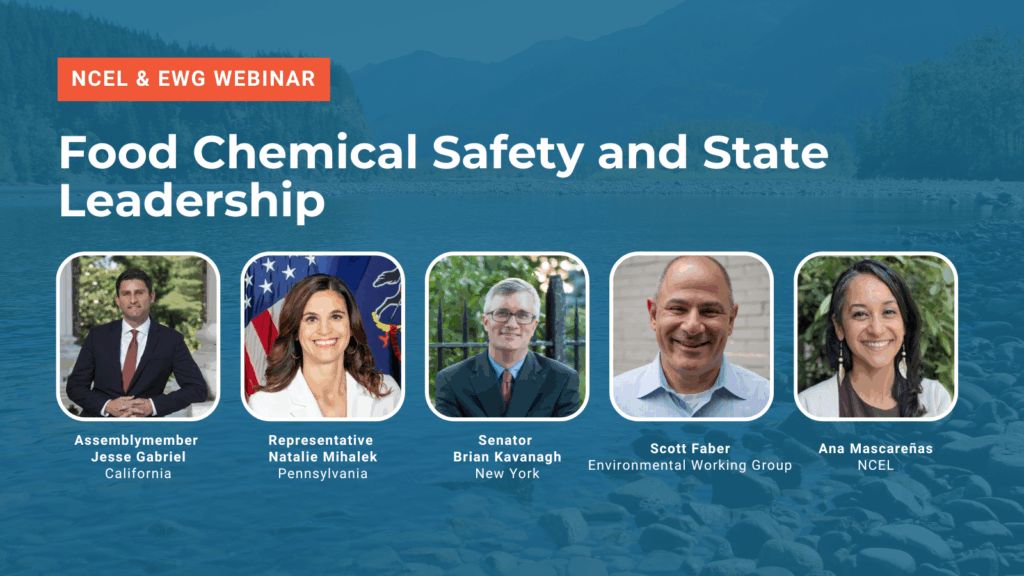
NCEL & EWG Webinar: Food Chemical Safety and State Leadership
November 10, 2025
Overview
On November 10, 2025, NCEL hosted a webinar in partnership with the Environmental Working Group (EWG) to spotlight how states are stepping up with bipartisan solutions to protect the public against harmful chemicals in food and food packaging.
The webinar consisted of a bipartisan panel of state lawmakers and focused on three key topics: (1) the federal landscape of food chemical law and regulation, (2) how bipartisan state legislators are demonstrating leadership, and (3) an explanation of how federal preemption of state laws could affect state progress.
- Why State Action on Food Chemicals Matters: Thousands of chemicals can be added to food and food packaging, but the U.S. Food and Drug Administration (FDA) lacks the resources to make sure they’re safe. In the absence of federal leadership, states have been leading the way. For example, 14 states have banned PFAS and BPA from food packaging, eight states have banned chemicals of concern from school foods, and three states have banned chemicals of concern from all foods. In response, many food companies have announced their intention to transition away from using harmful chemicals and dyes in their products in order to comply with state laws.
Panelists
- Assemblymember Jesse Gabriel, California
- Representative Natalie Mihalek, Pennsylvania
- Senator Brian Kavanagh, New York
- Scott Faber, Environmental Working Group
- Moderator: Ana Mascareñas, National Caucus of Environmental Legislators
Federal Landscape
On the federal level, there has been some action to address harmful food chemicals and address loopholes. One of the loopholes discussed during the webinar was the GRAS loophole, which allows companies to decide whether a food additive is “generally recognized as safe” with or without notifying the FDA. There are a number of bills that have been introduced in Congress over the past few years to address the food chemical regulatory system, including most recently S. 2341, H.R. 4306, and H.R. 4958. However, none have passed as of December 2025 — further underscoring the importance of state leadership on this issue.
Bipartisan State Leadership
There is growing bipartisan interest among state legislators in pursuing food chemical safety legislation to ensure that children have access to healthier food in schools. The public health and consumer-protection messaging has led to bipartisan sponsorship on these types of policies, ranging from bans on additives and dyes to PFAS in food packaging and other food-contact chemicals.
During the webinar, Pennsylvania Rep. Mihalek mentioned the strong bipartisan support and sponsorship of her 2025 bills targeting harmful food additives and ultraprocessed foods in schools (H.B. 1131 & H.B. 1132). Senator Kavanagh and Assemblymember Gabriel echoed this sentiment, sharing similar insights on bipartisan engagement in New York and California.
Bipartisan progress on harmful food chemicals was also seen in states like West Virginia (HB 2354), Virginia (HB 1910 / SB 1289), Oklahoma (SB 4), and more — often with health and childhood protections providing a powerful framing for garnering broad-based support.
Resources and Policies From the Webinar
Additional resources and state policies discussed during the webinar are included below. Please reach out to Nabjot Kaur, NCEL Environmental Health Program Manager, with any questions.
- California A.B. 1264 (Enacted, 2025): Prohibits ultraprocessed and restricted foods in public schools, mandates annual reporting, and defines “ultraprocessed food” and adopts regulations for “ultraprocessed foods of concern” and “restricted school foods” by June 1, 2028. Schools must begin to eliminate restricted foods by July 1, 2029, and vendors will be prohibited from offering them to schools starting July 1, 2032.
- New York S.1239E (Passed Senate, 2025): Prohibits certain food additives and food colors, such as the manufacture, sale, or distribution of food products containing FD&C Red No. 3, potassium bromate, or propylparaben for human consumption.
- New York S.3214A (Introduced, 2025): Prohibits the sale of foods and beverages containing synthetic color additives in schools except under certain circumstances. The additives banned include FD&C Red No. 3, Red No. 40, Blue No. 1, Blue No. 2, Green No. 3, Yellow No. 5, and Yellow No. 6.
- Pennsylvania H.B. 1131 (Introduced, 2025): Prohibits the sale or offering of ‘competitive foods’ containing certain artificial color additives on school grounds during the school day, including Blue 1, Blue 2, Green 3, Red 40, Yellow 5, and Yellow 6, identified by their Chemical Abstracts Service (CAS) numbers.
- Pennsylvania H.B. 1132 (Introduced, 2025): Prohibits the sale or offering of “competitive foods” containing “unhealthy ultra-processed foods” on public school grounds during the school day, effective July 1, 2027.
- Interactive map: Tracking state food chemical regulation in the U.S. | EWG